
The Wet Tropics of Queensland is one of the world’s most extraordinary natural places. In 1988, it was inscribed on the UNESCO World Heritage List after meeting all four natural World Heritage criteria—a distinction held by very few places worldwide.
Spanning approximately 895,000 hectares, the Wet Tropics World Heritage Area (the Area) contains some of the oldest continuously surviving tropical rainforests on Earth and is internationally recognised for its Outstanding Universal Value.
Outstanding Universal Value
Under the World Heritage Convention, there are ten criteria used to assess Outstanding Universal Value across natural and cultural heritage. A site must meet at least one criterion to be considered for World Heritage listing.
The Wet Tropics meets all four natural criteria. In addition to meeting these criteria, World Heritage properties must demonstrate integrity (their wholeness and intactness) and have appropriate protection and management to safeguard their values for future generations.
Other factors include the 'wholeness and intactness' of the natural and/or cultural heritage and whether there is adequate protection and management to safeguard its future.
Why is the Wet Tropics World Heritage-listed?
The Wet Tropics World Heritage Area is internationally recognised as a fragile haven of breathtaking beauty with timeless natural processes that showcase Earth's evolution.
The Area presents an unparalleled record of the ecological and evolutionary processes that shaped the flora and fauna of Australia, containing the relicts of the great Gondwanan forest that covered Australia and part of Antarctica 50 to 100 million years ago. All of Australia’s unique marsupials and most of its other animals originated in rainforest ecosystems, and their closest surviving relatives occur in the Wet Tropics. These living relicts of the Gondwanan era and their subsequent diversification provide unique insights to the process of evolution in general. They also provide important information for the interpretation of fossils of plants and animals found elsewhere in Australia, and about the evolution of Australia’s sclerophyll flora and marsupial fauna in particular.
The property supports tropical rainforests at their latitudinal and climatic limits, and unlike most other seasonal tropical evergreen equatorial forests, is subject to a dry season and to frequent cyclonic events. Many of the distinct features of the Wet Tropics relate to its extremely high but seasonal rainfall, diverse terrain and steep environmental gradients. In addition to its complex array of species and life forms, the Wet Tropics is also recognised as an area possessing outstanding scenic features, natural beauty and magnificent sweeping landscapes.
To help explain the natural values of the Area, each of the four natural World Heritage criteria has been paired with a simple tagline.
Breathtaking beauty
World Heritage criterion (vii)
Superlative natural phenomena or areas of exceptional natural beauty and aesthetic importance
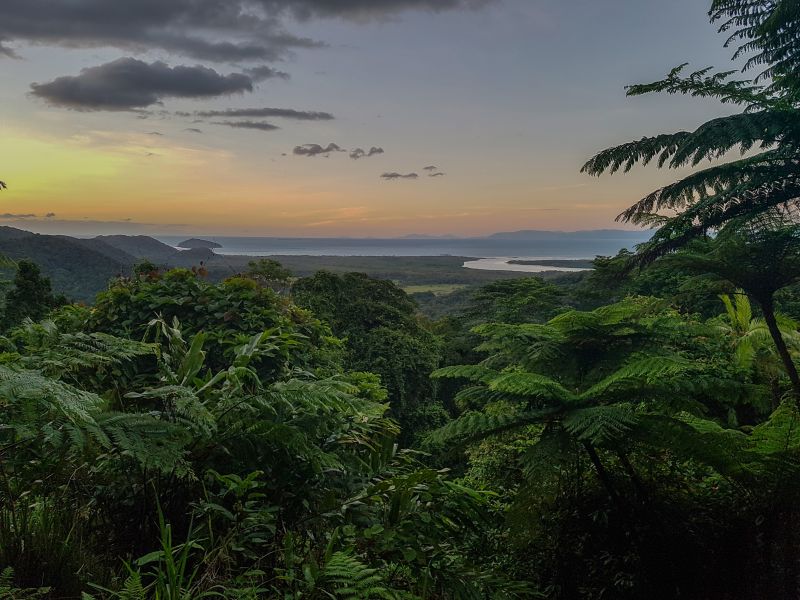
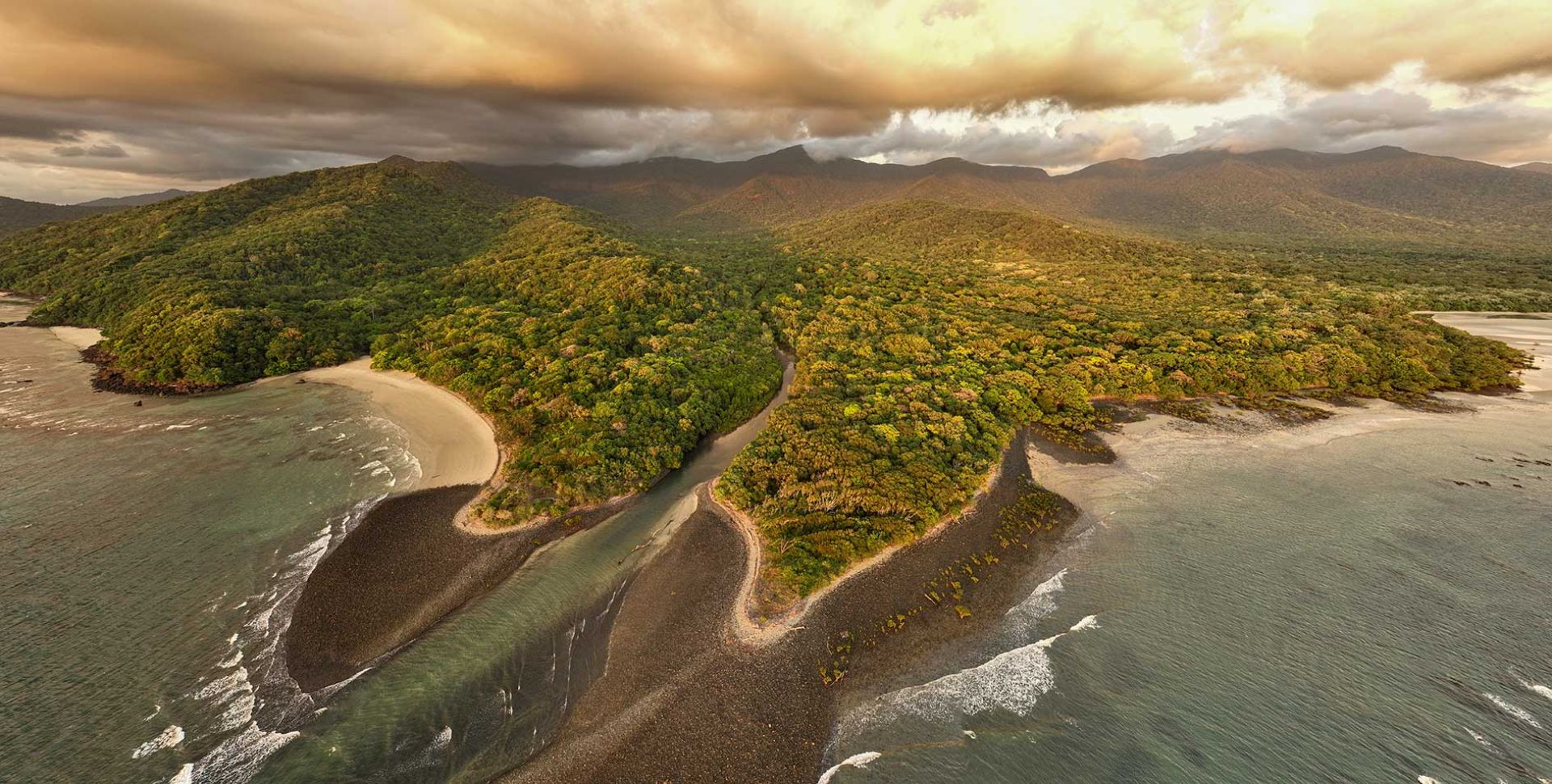
The Wet Tropics is renowned for its exceptional natural beauty and the contrast of spectacular landscapes. The sweeping vistas of undisturbed forest, mountain peaks, wild rivers, waterfalls, rugged gorges, and coastal views provide powerful opportunities to inspire visitors.
The concept of beauty is complex, and other features (such as species diversity and abundance; the contrast of plants, animals, shapes, colours and features; even the impression of solitude) can also influence the perception of beauty.
The Wet Tropics exhibit exceptional natural beauty, with superlative scenic features highlighted by extensive sweeping forest vistas, wild rivers, waterfalls, rugged gorges and coastal scenery. This is particularly apparent between the Daintree River and Cedar Bay, where exceptional coastal scenery combines tropical rainforest and white sandy beaches with fringing offshore coral reefs. The winding channels of the Hinchinbrook Channel contain the most extensive mangroves in the region, providing a rich visual mosaic of rainforest and mangroves, and a terrestrial continuum with the Great Barrier Reef.
Earth's evolution
World Heritage criterion (viii)
Outstanding examples representing the major stages of the Earth's evolutionary history, including the record of life, significant ongoing geological processes in the development of landforms, or significant geomorphic or physiographic features.
The Wet Tropics contains one of the most complete and diverse living records of the major stages in the evolution of land plants, from the very first pteridophytes more than 200 million years ago to the evolution of seed-producing plants including the cone-bearing cycads and southern conifers (gymnosperms), followed by the flowering plants (angiosperms). As the Wet Tropics is the largest part of the entire Australasian region where rainforests have persisted continuously since Gondwanan times, its living flora, with the highest concentration of primitive, archaic and relict taxa known, is the closest modern-day counterpart or Gondwanan forests. These modern-day examples of ancient Gondwanan forests are amongst the oldest continuously surviving tropical rainforests on Earth.
In addition, all of Australia’s unique marsupials and most of its other animals originated in rainforest ecosystems, and the Wet Tropics still contains many of their closest surviving members. This makes it one of the most important living records of the history of marsupials as well as of songbirds.
With living plants and animals representing ancient lineages and significant stages in evolution, the Wet Tropics offers fascinating insight into the diversity, development and survival of many species.
Here you will find one of the most complete and diverse living records of the major stages in the evolution of land plants, one of the highest concentrations of species of ancient lineages of flowering plants, and one of the most important living records of the history of marsupials and of songbirds.
Timeless natural processes
World Heritage criterion (ix)
Outstanding examples representing significant ongoing ecological and biological processes contributing to the development of ecosystems and communities of plants and animals.
From ancient links with Gondwana to the ongoing isolation of a drying continent, the Wet Tropics' plants, animals and landscapes have continuously adapted to change.
Over millennia, rainforests expanded and contracted, remaining stable only in the cool uplands and ever-wet gorges and valleys. The tall, open forests on the drier margins of the rainforest are significant as part of an evolutionary continuum of rainforest and sclerophyll forests.
The region’s geology, topography, rainfall, fire and weather have shaped diverse habitats that support outstanding biodiversity and an exceptionally high number of endemic species. This provides fundamental insights into evolutionary patterns both in isolation from and in interaction with other rainforests.
The Area supports an exceptionally high level of diversity of both flora and fauna.
Fragile haven
World Heritage criterion (x)
Contains the most important and significant natural habitats for in-situ conservation of biological diversity, including those containing threatened species of Outstanding Universal Value from the point of view of science or conservation.
While much of the World Heritage Area is rainforest, there are also mangroves, sclerophyll forests, woodlands and swamps. The plant communities of the Wet Tropics are recognised as being the most floristically and structurally diverse in Australia.
These unique environments provide the most important or only habitat for hundreds of species of plants and animals that are found nowhere else on Earth—some only exist in small numbers and/or have restricted distributions, having evolved for specific conditions, making the protection of their habitat critical for their survival.
The Wet Tropics holds a largely intact flora and fauna with hundreds of endemic species restricted to the property, of which many are classified as threatened. The majority of plant species have restricted distributions, and many monotypic plant genera and several species of marsupials, frogs and reptiles have very restricted distributions either as isolated or disjunct populations, reflecting the refugial nature of the rainforests found in several locations.
Together, these four criteria recognise the Area as a fragile haven of breathtaking beauty with timeless natural processes that showcase Earth's evolution.
Together, these four criteria recognise the Area as a fragile haven of breathtaking beauty with timeless natural processes that showcase Earth's evolution.
Australia's World Heritage obligations
When the Wet Tropics of Queensland was inscribed on the World Heritage List in 1988, Australia committed to managing this globally significant region by taking appropriate legal, scientific, technical, administrative, and financial measures to protect, conserve, present and rehabilitate its heritage.
In 1990, the Australian and Queensland governments signed the Management Scheme Intergovernmental Agreement for the Wet Tropics of Queensland World Heritage Area (the Intergovernmental Agreement).
The Intergovernmental Agreement (updated in 2012) outlines how both governments work together to manage the Area and implement Australia’s obligations under the World Heritage Convention by providing broad structural and funding arrangements. This led to the development of specific legislation for the Wet Tropics and the establishment of the Wet Tropics Management Authority.
Last updated: 13 Oct 2026